Winter Ice Storm Tree Emergencies in Moline Illinois
Ice storms hit the Quad Cities region with a particular ferocity that flat-landers elsewhere rarely experience. When a winter system rolls across the Mississippi River and temperatures hover just below freezing, every branch, twig, and trunk in Moline becomes a candidate for catastrophic failure. Unlike wind events that snap branches in a single gust, ice accumulation is a slow, grinding process — and by the time most homeowners realize the danger, their yard may already be a war zone of cracked limbs and downed wood pressing against their home, fence, or power lines.
Why Ice Storms Are Uniquely Dangerous for Trees
Ice is extraordinarily heavy. A single inch of ice accumulation can add more than 500 pounds of weight to a mature tree's canopy. Most healthy trees can absorb some of that load, bending and flexing as the ice builds overnight. But when temperatures remain below freezing for an extended period — a scenario Moline residents know all too well through January and February — the weight becomes relentless. Branches that appear fine at midnight can split at the union by dawn.
The structural failure points vary by species. Silver maples, which are common throughout the older neighborhoods along 7th Avenue and in South Moline, have naturally weak branch attachments and are among the first trees to suffer catastrophic splits during ice events. Ornamental pears and Bradford pears, planted widely in newer subdivisions near 53rd Street, are notorious for their tight, upright branching structure that funnels ice accumulation directly onto central leaders. Cottonwoods near the river corridor often shed massive limbs without warning.
The Hours After the Storm: What You Should and Shouldn't Do
The period immediately following a major ice event is both the most urgent and the most dangerous time for homeowners. Ice-laden branches remain under enormous tension even after the storm passes. A limb that looks like it has already settled may be holding several hundred pounds of ice against a partial crack — and the warmth of midday sun can trigger a sudden, violent release with no warning.
Stay inside or well away from the drip line of any tree showing visible cracks, hanging limbs, or unusual leaning. Do not attempt to knock ice off branches with poles, ladders, or any tool. The vibration alone can trigger a failure, and ice chunks falling from 30 or 40 feet carry enough force to cause serious injury. Keep children and pets indoors until a qualified crew has assessed the property.
If a limb has landed on your roof, do not go onto the roof to assess it yourself. Do not attempt to pull the limb free from ground level using ropes or vehicles — partially embedded branches under ice load can whip unpredictably when tension releases. Call for Emergency Tree Removal and describe the contact point accurately so the arriving crew can set up safely.
Conditions That Escalate a Tree Emergency
Not every broken branch in a Moline backyard constitutes a true emergency, but certain conditions push a situation into urgent territory. If a tree or large limb has contacted a utility line, treat the line as live regardless of whether lights are on in your home. Downed or contact-loaded power lines require Rock Island county utility response before any tree work can safely proceed. Do not approach within 30 feet of any wire on the ground.
Structural contact with a home is another immediate escalator. Ice-storm damage tends to be heavy and compressive rather than the slicing contact of a wind-thrown trunk. A large limb resting on a roof may be doing so across several feet of contact, and its weight can accelerate interior structural damage if left in place for days while temps remain below freezing.
Split trunks on trees adjacent to structures deserve immediate professional evaluation. A trunk that has partially split will often hold for hours or even a day before the remaining wood fibers give way — and that failure almost always happens when conditions change, either with temperature shifts or secondary wind. If you have a large tree showing a visible split within 30 feet of your home in neighborhoods like Floreciente or along River Drive, that situation warrants a same-day call.
What Crews Do Differently in Ice Conditions
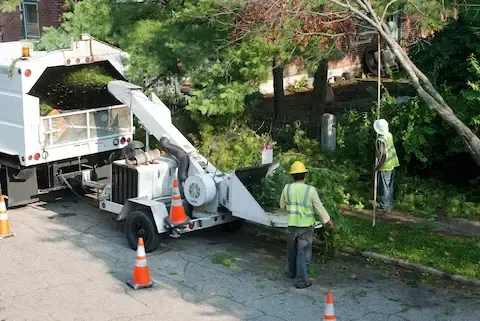
Professional arborists working in post-ice-storm conditions adapt their approach significantly compared to standard removal work. Ground conditions are treacherous — equipment operators account for reduced traction and altered weight distribution when positioning chippers and cranes on ice-covered lawns and driveways. Crews work from the outer canopy inward, removing weight in stages to control how a compromised tree or limb fails rather than allowing it to release unpredictably.
Rigging becomes more critical when standard felling isn't possible, which is frequently the case in the denser residential blocks of central Moline where lots are narrow and neighboring structures are close. Limbs are sectioned and lowered rather than dropped, which takes more time but eliminates secondary damage to fences, outbuildings, and neighboring property. For more on how our team approaches urgent situations year-round, read about Emergency Tree Removal response in the Moline area.
After the Emergency: Assessing What Remains
Once the immediate hazard is resolved, the work of evaluating remaining tree health begins. A tree that lost one or two major limbs to an ice storm may continue to thrive for decades with proper pruning and wound care. A tree that suffered a trunk split, significant crown loss, or root heave is in a different situation entirely and warrants a thorough assessment before you invest in its continued care.
Moline's urban tree canopy includes many trees that are already stressed from compacted soil, drought cycles, and the aging infrastructure of older neighborhoods. Ice damage that might be manageable for a young, vigorous tree in open soil can be the final event for a mature tree already fighting root competition or soil compaction along city parkways and boulevard strips. An honest evaluation after storm cleanup tells you whether recovery pruning makes sense or whether removal and replanting is the better path for your property long-term.
Planning Before the Next Ice Season
The most effective response to ice storm damage in Moline is the work done in autumn before the first freeze. Trees with co-dominant leaders, included bark, or significant deadwood are statistically far more likely to suffer catastrophic failure under ice load than trees that have been properly maintained. Late fall is an excellent window for structural pruning because trees are dormant, wounds callus well, and the canopy is visible without foliage obscuring the branch architecture.
If last winter left you with piles of brush and a bill you weren't expecting, the most practical investment this fall is a professional canopy assessment while the weather cooperates. Addressing structural defects before ice arrives is always faster, safer, and less expensive than emergency response after a storm has already done its worst.
